Showing posts with label Mario Batali. Show all posts

6/10/2017

Olive Oil and Fresh Rosemary Cake - Happy 21st!!


 Ever since the bit of time I spent in Greece, and subsequently buying Greek cookbooks, I've been intending to make one of those lovely olive oil cakes popular around the Mediterranean.   The idea is a little off-putting, but they have two good things going for them: 1.  the excellent taste and 2. the ease of putting one together.  Being as we are celebrating my grandson's 21st birthday today, and as I was making a chicken curry, my thought was that this Rosemary Olive Oil Cake would be an excellent dessert pairing , accompanied by a light sorbet.

11/02/2010

Heat by Bill Buford


 Heat: An Amateur’s Adventures as Kitchen Slave, Line Cook, Pasta Maker and Apprentice to a Dante-Quoting Butcher in Tuscany, by Bill Buford, our current Cook the Books Club selection, was a fascinating glimpse into life behind the scenes, at the three-star New York restaurant, Babbo.  Buford, a reporter and editor at the New Yorker, took on the commission of a profile on Mario Batali, larger than life, restaurant owner, Chef, TV personality, and author, with an extreme dedication.  This book is his account of the experience, which brought him to not only hook up with Batali, but to work for him, learning the food business firsthand, which he continued to do, even after his profile, The Secret of Excess, was completed.  Heat incorporates all that and much more, with  frequently humorous reflections on food, cultural influences and history.

I truly admire Buford's incredible verisimilitude in reporting.  To go through learning all the steps, from hours, months of mundane prep work, to apprenticing at the stations for pasta, grill work and plating, not to mention, of course, enduring the intense heat (physically and emotionally) back there in the kitchen, including real abuse from some of the chefs.  His book could have alternatively been titled, Life on the Line.  It sounded like hell to me.  Not anywhere I'd want to be.  Though, I'm glad he did, so we could read about it.  An outstanding read, which I truly enjoyed, perhaps excepting only the last section of the book, where for further hands on experience, he apprentices with a butcher in Tuscany.  Vegetarians should be forewarned. Too much gory detail, but hey, at least he got to hear Dante quoted in between times.  Didn't Dante write about hell?

All of which brought to mind a recent article in Bon Appetit, written by Molly Wizenberg, of the popular blog Orangette, entitled, "If you can't stand the heat...."  It was penned shortly after she had worked four months as a cook at Delanceys, Seattle, the restaurant Wizenberg and her husband had just opened.  As she tells it:
"But a restaurant kitchen operates at a speed and on a scale that few home kitchens will ever know...Great restaurant cooks thrive under pressure.  They're performers.  They may swear and sweat, but they like the challenge, the intensity, the urgency.  I am not a great restaurant cook.  I don't know if it's a matter of genes or temperament or both, but when faced with a dozen orders, I do not get an adrenaline rush.  I get weepy....
I didn't understand this until I worked in our restaurant, but for me, cooking is not a performance.  It's more intimate, more private than that.  I like a small kitchen."
Yes, exactly, as I frequently feel that way in my very own, quiet, little kitchen.  I often want out of there, it's just too darn hot.  And, the pressure!  I mean, getting a meal on the table that tastes good, is composed in a balanced way, and served some time before The Late Show?  As intense as I want to get.  Actually, to be honest, I don't like entertaining all that much, for the above reasons.  It's not entertaining me any.  I'd rather go out, let someone else do the sweating.  Don't get me wrong, I do enjoy cooking, trying new things, serving delicious food to the people I love, .....eating.  But, no pressure.  Mixed feelings, I guess.

2/01/2010

Recipes to Rival: Eggplant Parmesan

These were so pretty, calling to me from the market produce bin, I couldn't resist.  And, that purple-flowered basil matches so well.  However, don't know about the rest of you, but I tend to forget things in my fridge.  They were fast approaching their "use by" date, when I finally had everything together for Eggplant Parmesan, Mario style, our latest Recipes to Rival dish, hosted by Temperance at High on the Hog.

Most of my family (extended included) don't really care for eggplant, so the real challenge is always to make it so they can hardly resist.  Quite a feat for my granddaughter especially.

The dish was good, though I really don't see the point of those individual towers, other than for cute servings.  I think it works easier and just as good to layer them in the ordinary way.  The towers likely derived from the whole haute gourmet plating style in restaurants, where everything has to be artfully stacked on top of each other.  Just my opinion.  Also, I think my usual recipe tastes lighter.  I first roast the eggplant slices with just a brushing of olive oil.  I had to use way too much  in this.  Probably the oil wasn't hot, hot, hot enough??  Really not sure.  But, there certainly wasn't any left in the pan after the first batch was done.  Had to keep adding more.  Also, if you roast the eggplant, there's no need for any breading.  You can just sprinkle the herbs on when layering.
For the recipe - 

5/26/2009

Duck Confit in White Wine Reduction


For this dish I used my Confit of Duck legs topped with a sauce of white wine, Kaffir lime zest and Galangal ginger - an important and popular ingredient in the foods of Indonesia and Southeast Asia, especially in Thailand. For those of you unfamiliar with this Asian spice, here is some history and benefits from a Thai cooking site I came across in my search for the best ways of preparing the fresh root. I wanted to concoct a pan sauce that would both counter and complement the rich, unctuousness of the duck. Something light and zippy.


History of Galangal

Galangal is now grown in most Southeast-Asian countries, but was first harvested for use in cooking and medicine in China and Java. But by the Middle Ages, galangal had traveled extensively, and was already in common use throughout Europe. Referred to as "the spice of life" by St. Hildegard of Bingen (1098-1179), galangal was, in fact, one of her favorite remedies. This famous herbalist used galangal to treat everything from deafness and heart disease to indigestion.
During the 13th-14th centuries, galangal was used by the Turkic peoples (who occupied much of present-day Russia) as a tea, and by the Arabs as a stimulant for their horses. It was used extensively throughout the East as a snuff for nasal infections, and in both Europe and Asia as an appetite stimulant and aphrodisiac.
Today, galangal is still in use in Russia, where it is used to make vinegars as well as liqueurs. It also has a thriving market in India, where it is not only valued as a spice but also as a perfume to make deodorants. Presently galangal remains, however, most commonly used in Southeast-Asian countries like Thailand, where the spice is not only a medicine, but has become part of the daily diet-which tells you how healthy Thai cuisine really is!


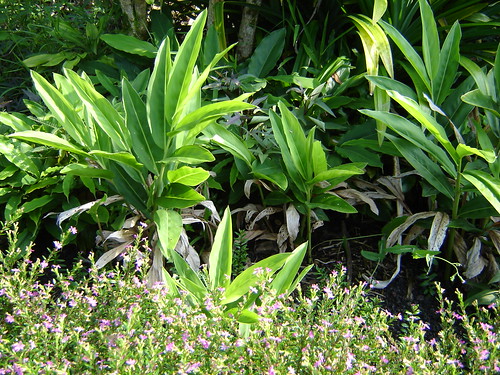
So, enough about that particular ingredient. I love it though, and am cultivating even more to supply my habit, since it does so well in Hawaii. Here's my little bed of galangal, behind the Mexican Heather.


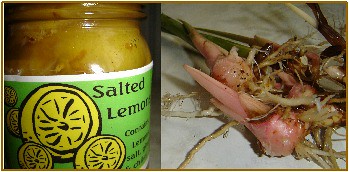
Another ingredient from our garden is the lemon factor, both in my Lemon Mead and Preserved Lemons. You can see the gnarly galangal roots here.  The Kaffir lime used for its zest is also home grown.

 Confit of Duck, is an incredibly delicious and succulent preparation involving a salt cure, then slow cooking submerged in duck fat.  Though if you are in a hurry, it can be bought prepared. Or if the duck fat puts you off, you can use olive oil. I like to buy a whole duck, break it down, render the fat and use that. Aside from making confit with the giblets and legs, it's great for frying up potatoes, as I did for this meal.


The duck is preserved beneath a lovely blanket of duck fat, 3 weeks in the fridge, then brought to room temperature (so the tender meat won't pull off when you remove it).

Duck Confit with White Wine Reduction

This dish was partly inspired by Mario Batali's recipe for Duck with Preserved Lemons and Kumquat Vinaigrette from his book, The Babbo Cookbook.

Serves 2

2 confit of duck legs
1 tablespoon duck fat, grapeseed oil or olive oil
1/2 onion
3/4 cup duck or chicken stock
3/4 cup dry white wine (I used my lemon mead)
2 tablespoons galangal ginger, finely minced and pounded in mortar or food processor
1/2 teaspoon kaffir lime zest
1 tablespoons honey (taste, you may want more)
salt and white pepper to taste
for garnish - 1 preserved lemon quarter - skin only, rinsed and sliced thinly

Preheat oven to 350F

First, remove your duck legs (brought to room temp.) from the fat, and wipe down excess with a paper towel. In an ovenproof saute pan, heat the tablespoon of duck fat or grapeseed oil (does well at high temperatures) over high heat until smoking. Add duck legs and saute them, skin side down, until the skin is crispy. Remove pan from the heat and place it in the oven to heat through, for about 5 minutes. Plate and set aside, covered with foil, to keep warm.

In the same pan, saute the onion, until translucent and turning golden brown, then add galangal, and saute a few more minutes, add stock and wine. Reduce by half the amount over medium-high heat. Lower the heat, and add your kaffir lime zest and honey. Simmer gently about 5 minutes.

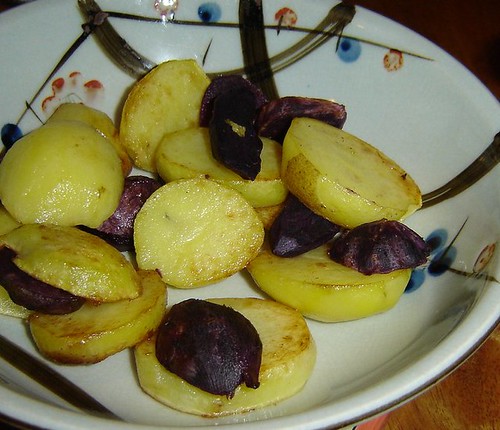
Pour over the duck and garnish with preserved lemon slivers. Serve with a salad of mixed greens (Ruhlman suggests a salad of arugula, red onions and and cerignola olives). I used arugula from our garden, some romaine lettuce and red onion macerated in Sherry vinegar. Amazing served with potatoes pan-fried in duck fat. Soooo good. I added in a few little sweet potatoes from my garden too.  Nice with a glass of dry Lemon Mead.


So, all in all, this meal used a number of items home grown, and I'll be sending it along to enter in the May Grow Your Own event, hosted this time by The Daily Tiffin.

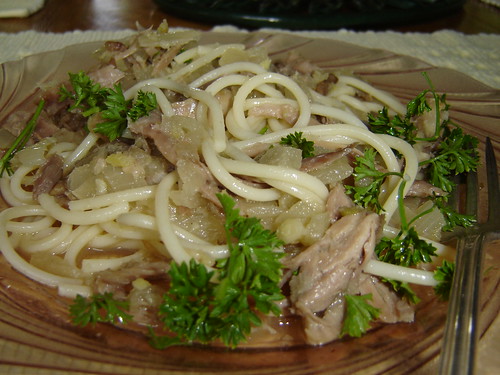
As a short addendum, there was just enough sauce and duck left to have over pasta for my lunch next day. Topping with a bit of parsley was a good flavor and color note. I'd add it to the main dish next time.