5/26/2009

Duck Confit in White Wine Reduction


For this dish I used my Confit of Duck legs topped with a sauce of white wine, Kaffir lime zest and Galangal ginger - an important and popular ingredient in the foods of Indonesia and Southeast Asia, especially in Thailand. For those of you unfamiliar with this Asian spice, here is some history and benefits from a Thai cooking site I came across in my search for the best ways of preparing the fresh root. I wanted to concoct a pan sauce that would both counter and complement the rich, unctuousness of the duck. Something light and zippy.


History of Galangal

Galangal is now grown in most Southeast-Asian countries, but was first harvested for use in cooking and medicine in China and Java. But by the Middle Ages, galangal had traveled extensively, and was already in common use throughout Europe. Referred to as "the spice of life" by St. Hildegard of Bingen (1098-1179), galangal was, in fact, one of her favorite remedies. This famous herbalist used galangal to treat everything from deafness and heart disease to indigestion.
During the 13th-14th centuries, galangal was used by the Turkic peoples (who occupied much of present-day Russia) as a tea, and by the Arabs as a stimulant for their horses. It was used extensively throughout the East as a snuff for nasal infections, and in both Europe and Asia as an appetite stimulant and aphrodisiac.
Today, galangal is still in use in Russia, where it is used to make vinegars as well as liqueurs. It also has a thriving market in India, where it is not only valued as a spice but also as a perfume to make deodorants. Presently galangal remains, however, most commonly used in Southeast-Asian countries like Thailand, where the spice is not only a medicine, but has become part of the daily diet-which tells you how healthy Thai cuisine really is!
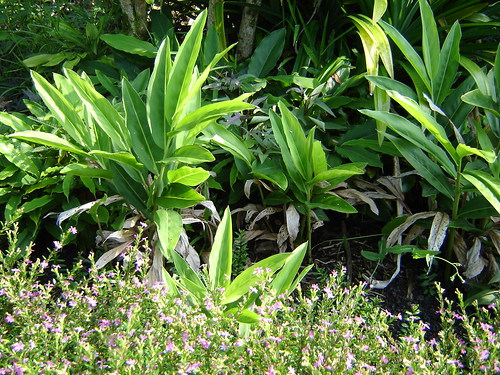

So, enough about that particular ingredient. I love it though, and am cultivating even more to supply my habit, since it does so well in Hawaii. Here's my little bed of galangal, behind the Mexican Heather.
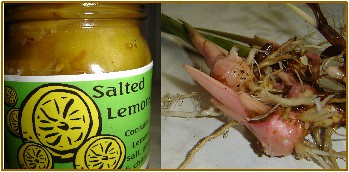


Another ingredient from our garden is the lemon factor, both in my Lemon Mead and Preserved Lemons. You can see the gnarly galangal roots here.  The Kaffir lime used for its zest is also home grown.

 Confit of Duck, is an incredibly delicious and succulent preparation involving a salt cure, then slow cooking submerged in duck fat.  Though if you are in a hurry, it can be bought prepared. Or if the duck fat puts you off, you can use olive oil. I like to buy a whole duck, break it down, render the fat and use that. Aside from making confit with the giblets and legs, it's great for frying up potatoes, as I did for this meal.
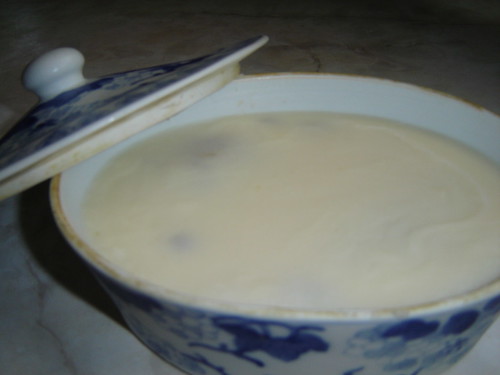

The duck is preserved beneath a lovely blanket of duck fat, 3 weeks in the fridge, then brought to room temperature (so the tender meat won't pull off when you remove it).

Duck Confit with White Wine Reduction

This dish was partly inspired by Mario Batali's recipe for Duck with Preserved Lemons and Kumquat Vinaigrette from his book, The Babbo Cookbook.

Serves 2

2 confit of duck legs
1 tablespoon duck fat, grapeseed oil or olive oil
1/2 onion
3/4 cup duck or chicken stock
3/4 cup dry white wine (I used my lemon mead)
2 tablespoons galangal ginger, finely minced and pounded in mortar or food processor
1/2 teaspoon kaffir lime zest
1 tablespoons honey (taste, you may want more)
salt and white pepper to taste
for garnish - 1 preserved lemon quarter - skin only, rinsed and sliced thinly

Preheat oven to 350F

First, remove your duck legs (brought to room temp.) from the fat, and wipe down excess with a paper towel. In an ovenproof saute pan, heat the tablespoon of duck fat or grapeseed oil (does well at high temperatures) over high heat until smoking. Add duck legs and saute them, skin side down, until the skin is crispy. Remove pan from the heat and place it in the oven to heat through, for about 5 minutes. Plate and set aside, covered with foil, to keep warm.

In the same pan, saute the onion, until translucent and turning golden brown, then add galangal, and saute a few more minutes, add stock and wine. Reduce by half the amount over medium-high heat. Lower the heat, and add your kaffir lime zest and honey. Simmer gently about 5 minutes.

Pour over the duck and garnish with preserved lemon slivers. Serve with a salad of mixed greens (Ruhlman suggests a salad of arugula, red onions and and cerignola olives). I used arugula from our garden, some romaine lettuce and red onion macerated in Sherry vinegar. Amazing served with potatoes pan-fried in duck fat. Soooo good. I added in a few little sweet potatoes from my garden too.  Nice with a glass of dry Lemon Mead.
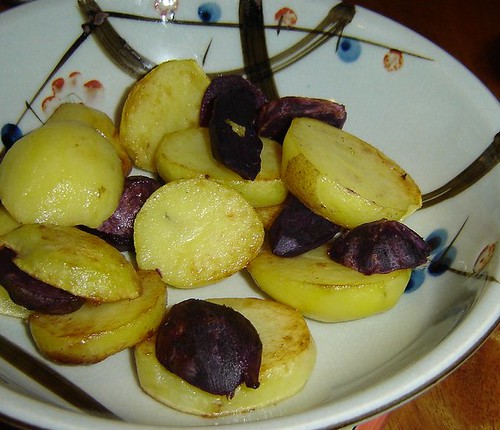

So, all in all, this meal used a number of items home grown, and I'll be sending it along to enter in the May Grow Your Own event, hosted this time by The Daily Tiffin.

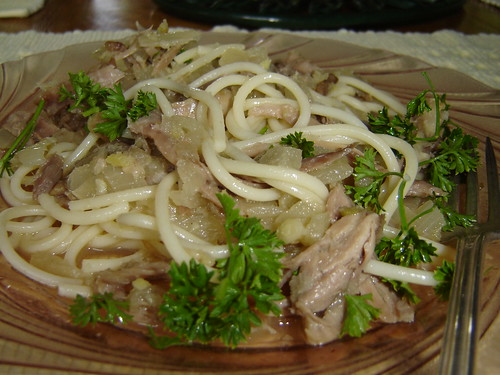
As a short addendum, there was just enough sauce and duck left to have over pasta for my lunch next day. Topping with a bit of parsley was a good flavor and color note. I'd add it to the main dish next time.
5/23/2009

Blue Blueberry Muffins


I confess. I have a love for murder mysteries. And food. And humor. Then, when you combine it all, you get triple enjoyment. These muffins are from a book I'm now in the middle of, Blueberry Muffin Murder, by Joanne Fluke. There's a mystery here, as well as wit and good recipes. Nothing deep folks, it's light entertainment for the end of my day.

The secret to these Blue Blueberry Muffins is the addition of blueberry pie filling, which gives an extra zap of the berry flavor and color. Then, they're finished with a Crumb Topping, to which I made my only change. For part of the flour I substituted some oat bran, to give a bit more crunch and taste. I had a late breakfast this morning, but it was worth the wait.


I've read some of her other mysteries and would recommend them also, if you're into this particular genre. I like to mix them in with other sorts of fiction. Now, to mix up the muffins:

Blue Blueberry Muffins
From the Blueberry Muffin Murder by Joanne Fluke

Preheat oven to 375F
rack in the middle position

3/4 cup melted butter (1 1/2 sticks)
1 cup sugar
2 beaten eggs (just whip them up with a fork)
2 teaspoons baking powder (make sure there's no lumps)
1/2 teaspoon salt
1 cup fresh or frozen blueberries (no need to thaw if they're frozen)
1/2 cup blueberry pie filling
2 cups, plus 1 tablespoon flour (no need to sift)
1/2 cup milk

Crumb Topping:
1/2 cup sugar (I would probably use brown next time)
1/4 cup flour
2 tablespoons oat bran
1/4 cup softened butter (1/2 stick)

Butter the bottoms only of a 12-cup muffin pan (or line the cups with cupcake papers). Melt the butter. Mix in the sugar. Then add the beaten eggs, baking powder and salt, and mix thoroughly.

Put the extra one tablespoon of flour in a plastic bag with your cup of fresh or frozen blueberries. Shake it gently to coat the berries, and leave them in the bag for now.

Add 1 cup of the remaining flour to your bowl and mix it in with 1/2 of the milk. Then add the rest of the flour and milk and mix thoroughly.

Now, the fun part: Add 1/2 cup blueberry pie filling to your bowl and mix it in. (Your dough will turn a shade of blue, but don't let that stop you - once the muffins are baked, they'll look just fine.) When your dough is well mixed, fold in the flour-coated berries.

Fill the muffin tins 3/4's full and set them aside. If you have dough left over, butter the bottom of a small tea-bread size loaf pan and fill it with your remaining batter. My muffin tin is the regular size and I had extra for the tea loaf. If you have the bigger size muffin pan, there will be just enough.

Make the crumb topping: Mix the sugar, flour and oat bran (if using) in a small bowl. Add the softened butter and cut in until crumbly. Sprinkle the topping over the muffins and bake at 375F for 25-30 minutes. The tea bread should bake about 10 minutes longer than the muffins.)

The author recommends freezing the remaining pie filling in 1/2 cup portions (paper cups in zip-lock bags) for making muffins later. You could also heat and use it for topping waffles!

These are now my favorite blueberry muffins. Sooo good. Enjoy.

As an addendum, I am adding a recipe for Blueberry Pie Filling, as it is so simple, I usually make my own. Cut the amounts down as you wish.

Blueberry Pie Filling

5 cups (~150 g)  blueberries
3/4 cup (131 g) granulated sugar
2 tablespoons cornstarch
2 tablespoons unbleached all-purpose flour
1/2 teaspoon cinnamon
2 tablespoons strained blueberry juice

1. Combine sugar, flour, cornstarch, and cinnamon in separate bowl and set aside.

2. Put frozen blueberries in a glass bowl and microwave on high to thaw, about 1 to 2 minutes. Put thawed berries into a mesh strainer and strain well, reserving 2 tablespoons of the liquid. This is important because too much liquid will make a soggy pie (or muffin).

3. Combine dry ingredients and blueberries in stainless pan. Stir gently until mixture is well-blended while adding the strained juice.

4. Simmer over medium heat until thickened.   Let it cool and bottle or freeze in plastic bags.

5/11/2009

Garbage In Garbage Out

My granddaughter offered me the choice of one of her TicTacs or a stick of gum. Neither one was at all tempting. Usually the only time I'll have some gum is if my ears are popping on an airplane. Sodas don't tempt me either. All that sugar (or sugar substitute) and misc. ingredients are very off-putting for some reason.

I found this article, leapfrogging from Organically cooked, as we habitually do on the web, and thought it worth posting the main points here too, as it reinforces what I've been mulling over, and talking about for some time. You may think it freaky that I'd eat some mushrooms growing wild outdoors, but shopping in your local supermarket can prove more dangerous to your health.

From the article reviewing Michael Pollan's lecture: 7 Rules for Eating
Choose Food Over Food-Like Substances,
By Daniel J. DeNoon
WebMD Health News
Reviewed by Louise Chang, MD

March 23, 2009 -- Food author Michael Pollan in a lecture given last week to an overflow crowd of CDC (Centers for Disease Control and Prevention) scientists.

As part of an effort to bring new ideas to the national debate on food issues, the CDC invited Pollan -- a harsh critic of U.S. food policies -- to address CDC researchers and to meet with leaders of the federal agency.

"The French paradox is that they have better heart health than we do despite being a cheese-eating, wine-swilling, fois-gras-gobbling people," Pollan said. "The American paradox is we are a people who worry unreasonably about dietary health yet have the worst diet in the world."

In various parts of the world, Pollan noted, necessity has forced human beings to adapt to all kinds of diets.

"The Masai subsist on cattle blood and meat and milk and little else. Native Americans subsist on beans and maize. And the Inuit in Greenland subsist on whale blubber and a little bit of lichen," he said. "The irony is, the one diet we have invented for ourselves -- the Western diet -- is the one that makes us sick."

Snowballing rates of obesity, diabetes, and heart disease in the U.S. can be traced to our unhealthy diet. So how do we change?

7 Words & 7 Rules for Eating

Pollan says everything he's learned about food and health can be summed up in seven words: "Eat food, not too much, mostly plants."

Probably the first two words are most important. "Eat food" means to eat real food -- vegetables, fruits, whole grains, and, yes, fish and meat -- and to avoid what Pollan calls "edible food-like substances."

Here's how:

  1. Don't eat anything your great grandmother wouldn't recognize as food. "When you pick up that box of portable yogurt tubes, or eat something with 15 ingredients you can't pronounce, ask yourself, "What are those things doing there?" Pollan says.
  2. Don’t eat anything with more than five ingredients, or ingredients you can't pronounce.
  3. Stay out of the middle of the supermarket; shop on the perimeter of the store. Real food tends to be on the outer edge of the store near the loading docks, where it can be replaced with fresh foods when it goes bad.
  4. Don't eat anything that won't eventually rot. "There are exceptions -- honey -- but as a rule, things like Twinkies that never go bad aren't food," Pollan says.
  5. It is not just what you eat but how you eat. "Always leave the table a little hungry," Pollan says. "Many cultures have rules that you stop eating before you are full. In Japan, they say eat until you are four-fifths full. Islamic culture has a similar rule, and in German culture they say, 'Tie off the sack before it's full.'"
  6. Families traditionally ate together, around a table and not a TV, at regular meal times. It's a good tradition. Enjoy meals with the people you love. "Remember when eating between meals felt wrong?" Pollan asks.
  7. Don't buy food where you buy your gasoline. In the U.S., 20% of food is eaten in the car.
He's even done a Manifesto. Altogether, I found his ideas helpful, also echoing what Michael Ruhlman has to say about the food industry and our cooking/ eating habits, joined by some other well-known chefs, food writers in this debate.

There is a spiritual parallel here. What the world serves up as true and right, depending on the cultural norms of the time and place, the politically correct thing to believe, ain't necessarily so. We are blessed to have our Creator's Word on the subject of truth, the Operating Manual as it were, for life. Just as we want to get our water filtered and pure, before we drink it down, there's for sure a lot of garbage that needs sorting out of what goes into our belief systems.

Another good parallel is the time issue. We don't have time to shake a few ingredients together in a bottle for our own salad dressing, but we can find the time to comment endlessly on blogs, or... We don't have time to spend meditating on Scripture and in prayer but... what are our priorities supposed to be anyway?

5/09/2009

I Didn't Die

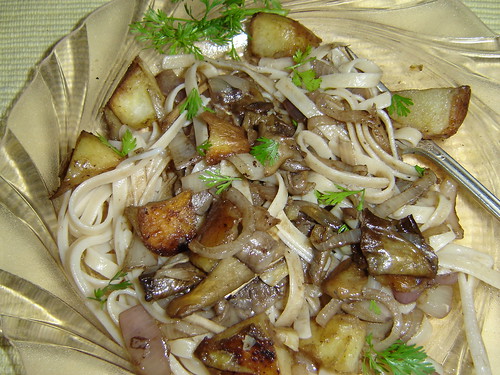
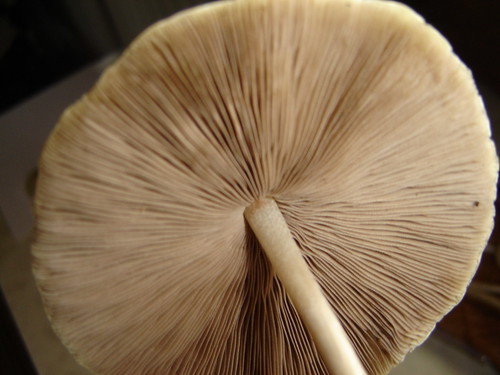
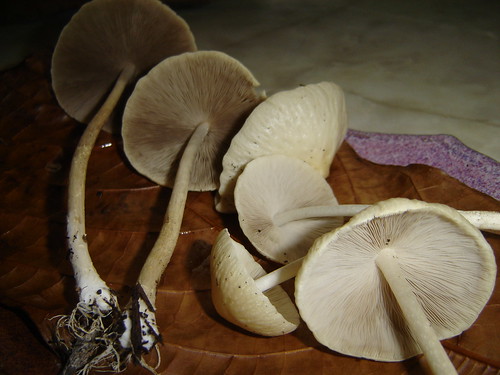
I thought I was being the original foraging, frugal gourmet, when someone I trusted identified my find as Almond Portobellos, or Agaricus subrufescens. He thought he detected the signature almond scent. I didn't but thought it must just be very faint. Oh goodie! Reassured with a quick glance at a reference book, I immediately sauteed them up with herbs, a few leftover veggies, and butter, topped some pasta with it, and voila, lunch. They were quite good, though no almond taste either, I thought, while reading further in my Mushrooms of Hawaii book. Funny, they also didn't meet a few other criteria. No annulus near the apex, no yellow bruising on lower half of the stalk when touched. Oh Boy. Dum de dum dum...

No, I didn't die. Or get sick, force myself to throw them up, or even have indigestion later.


Further reading in the mushroom identification guide leads me to believe what I ate was Agrocybe procera. They seem to have all the qualifications. I'm presently doing a spore print, which should help. Thing is, the book says, Edibility: unknown. Maybe I'm contributing to mycology here. Using myself as a guinea pig. I don't recommend this technique.


If anyone else wants to contribute their professional or amateur gourmet opinion, feel free. Another quote from the book which sort of worries me: "Although we are unable to identify this species with certainty, it is very similar to Agrocybe procera, described from Chile."


They were growing in wood chips compost, by the way.


Also, the gills turn brown with more maturity. I wonder, should I eat the ones I picked this morning?

Monday afternoon update: I visited the charming Dr. Don Hemmes, Mycologist and co-author of the above referenced mushroom identification guide, at the University this morning, with my spore print and some sample mushrooms. He confirmed their tentative species as the Agrocybe procera, and had a good story of the only (aside from me) other eating experience he'd heard of. He was called to the emergency room at Hilo Hospital to examine some mushrooms the parents of a 5 yr. old child brought in with the the little girl, who had apparently ingested a large quantity of them. When they were asked about why she did this, her two older brothers were observed to be sheepishly studying the floor. They had given her some story as to why she should eat those magic mushrooms. Well, she didn't turn into a fairy, or get sick either. I didn't even have the excuse of thinking they were magical. Just edible.

5/04/2009

A Lovely Bunch of Coconuts

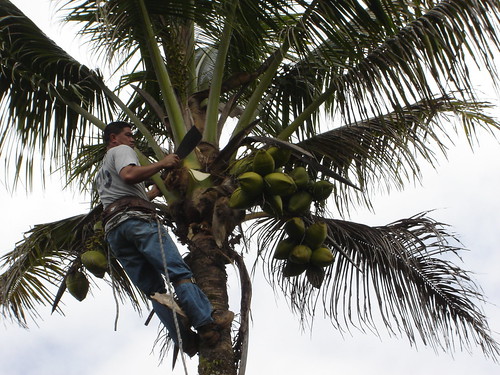
Coconuts are one of the fruits (nuts?) of the garden I don't do anything with. Bob used to open them for me, then I'd grate the meat and make coconut cream or use the toasted shreds in my homemade granola. No more. I'd like to, coconut milk or cream is also wonderful in curries, but there's only so much time and energy available. Thus, an alternative is necessary. Some nice Tongans came over and dealt with the lovely bunches of coconuts. Three trees full. We don't want those heavy suckers falling on someone's head. The Tongan gentleman took home some of the green ones, told me he feeds them to his chickens.


He made it look so easy. Walking up that tree, then whack, whack, whack. Part of the cost of living in Hawaii.

4/21/2009

Banana Crepes

This is another, and highly recommended way of dealing with bananas. Just one of many things you can do with that wonderful fruit. I make my usual crepe recipe, which I've just noticed does not fit the ratio of Ratio, Michael Ruhlman's new book. But it's a favorite, originally from my mother-in-law, revised by myself, tried and true over many years. So, first whip up the crepes, and set aside (which is good for the batter) then, saute some bananas in butter, the amount depends on how many people will be eating them. For two of us, I sliced up about 5 small ones. We grow what are called Apple Bananas and they are so sweet and flavorful. Add a bit of nutmeg, cardamom, cinnamon, vanilla, (not all of the above) or get fancy and flame some rum.

We put a little trail of jam (this is Starfruit Marmalade) on our crepes, then the bananas, add a bit of sour cream or yogurt, roll it up and top with powdered sugar or syrup. Bob uses syrup and I like the effect of a dusting of sweet white on top. Eat, then do another, and on and on...

My Crepes recipe:
3 eggs
1/2 stick butter, melted
1 cup flour
1 1/4 - 1 1/2 cups milk

Beat the eggs well and add in some of the milk, and the flour, whipping like crazy with a wire whisk til smooth (this is the tricky part - avoiding lumps) and enough remaining milk, so that the batter still coats your spoon. Beat in the melted, slightly cooled butter. Pour about 1/4 cup batter in a hot crepe pan, with a tiny bit of butter first, if necessary, swirling around to coat the pan's bottom. Flip and do the other side.
This amount usually makes enough for us to have crepes for breakfast and a crepes dinner of some sort later, so I don't add any sugar to the batter. Not necessary. It's also another very delicious way of using some left-overs, which I did last night.

I was reading in my journal of ten years ago this morning, and my entry for April 21 was:
We are tenants in the vineyard of God's love - designed to produce fruit for his kingdom.
And this quote from Marcus Aurelius', Meditations:
As the earth is a pinpoint in infinite space, so the life of man is a pinpoint in infinite time - a knife-edge between eternities.
A good reminder to make the most of what I'm given.

4/16/2009

Queen's Surf Banana Muffins

Well, after my silly rants on the last post, I thought I'd share these awesome banana muffins with you. They're an old favorite, and I do mean old. The recipe originally came from the popular Queen's Surf restaurant in Waikiki, which was torn down years ago. Note below for a bit more of the history.  I occasionally make a few updates, of course. There's crunchy, toasted macadamia nuts and chunky, crystals of raw sugar on top. I added some grated lemon zest, for a bit of citrus zing, and a little nutmeg and ground cardamom to heighten that mellow banana flavor.

What usually sets me off on a recipe quest is the sight of something like this. And the awareness of 4, yes four more large bunches of bananas in various stages of ripening. Have I mentioned just how good these sweet little Apple Bananas are? Got to be the most sought after variety for growing here in Hawaii.


So, out comes the faithful recipe card for banana muffins from the Queen's Surf. I'm also going to try Ilva's Chocolate Banana Bread, posted just the other day (her April 10th entry). Maybe with big chunks of dark chocolate. Yum.

Over the years, I've tried various and sundry additions to the basic recipe, dried or fresh fruits - pineapple is especially good, nuts in or on top, brown sugar, or honey, instead of the original plain sugar. This time I used brown sugar, a full, packed 1/2 cup, instead of the 3/4s cup sugar called for, which to me, is sweeter than I prefer. The flavors were heightened with lemon zest from one lemon, 1/2 teaspoon cardamom and 1/2 teas. nutmeg. Also, I used AP flour instead of cake, which I never seem to have on hand, and sifted only once with all the other dry ingredients, instead of three times. One day, I'm actually going to do what I'm told, just to observe the difference, if any. I may also separate the eggs and whip the whites to fold in next time. Here, I'll give you the historic, original version, for tradition sake, cut down to proportions for one dozen.

The Queen's Surf Banana Muffins
Ingredients:

3/4 cup sugar
1 stick butter (4 oz)
3 ripe bananas, mashed (a few bigger chunks are ok) and double the amount for smaller varieties like the Apple Banana
2 eggs
1 1/4 cups cake flour
1/2 teas. salt
1 teas. baking soda
Cream sugar and softened butter, add bananas and well beaten eggs. Sift dry ingredients together three times and blend with batter. Don't over-mix.

Pour into greased muffin pan and bake at 350F for 25-30 minutes. Cool on rack and enjoy!


These muffins were topped with sprinkles of raw Turbinado sugar and toasted, chopped macadamia nuts. If you don't happen to have macadamia trees in your garden, like I do, pecans or walnuts would be great. And, since the bananas, lemon and mac nuts are grown by us, I'm entering this post in April's edition of the Grow Your Own event.


For some background information notes:

Queen's Surf Restaurant and Nightclub

Queen’s Surf, built 1916 across from Kapiolani Park on Waikiki Beach, became Fleischmann’s Yeast heir, Chris Holmes' beach house in1933. Acquired by the city of Honolulu around 1946, following Holmes’ death, it was leased to Spencecliff Corporation which operated it as the hugely popular Queen’s Surf Restaurant and Nightclub. Closed down 1969 by Honolulu Mayor Frank Fasi in a lease dispute the building was demolished in1971.

4/11/2009

Good Griefs and Greetings

He Has Risen!
It's the Greek Easter greeting (in Greek of course). I'm supposed to be cleaning my house, but instead, guess what's being done? This. Meanwhile the windows are dirty and the mini-blinds are dusty. Though, I discovered today the origins of "Spring Cleaning" - likely not news to anyone else. It's the Jewish tradition of getting rid of all the chametz in the weeks before Passover. Anything with a possibility of yeast, mold, dust, dirt, etc. etc. All of which are symbolic of the yuck in our spiritual lives - sin in other words. That word no one wants to use anymore.

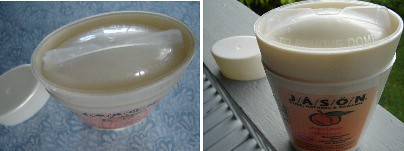
On another note - get ready for a rant. Observe this packaging. A lovely graphic, the product sounds good, apricot scented deodorant, pure, natural and organic. For sensitive skin. But go ahead, try to get it open. My sensitive skin is turning red. Do they try extra hard thinking up ways to make things difficult for consumers? Just for a laugh? This is similar to the "child-proof" aspirin bottles. Have you ever tried, in the grip of a raging headache, to get the top off one? Or pity the poor arthritis sufferer, with pain in her hands? Hey, and I've yet to meet the child who couldn't get those tops off in nothing flat.


The directions are there, if you can read them. They can be barely made out, tilting it at an angle, standing in good light. It's clear on clear, for easy reading. Then try to do what it says: "to remove dome twist up product." Right, if it only would. Twist, move, get off! I'm going to need my grandson for this. As a PS - I did try twisting from the bottom (at first I was afraid that would just smash deodorant up against the lid dome) so yes, success at last. It wasn't the obvious, and it wasn't clear. Clear directions don't necessarily clarify.


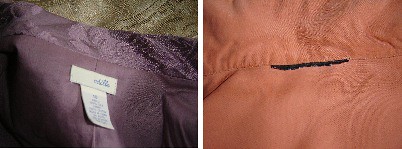
Here's another pet peeve - those labels in shirts made of unfortunate, synthetic, hyper-itchy materials, designed by their manufacturers to torment consumers. On purpose. You can buy a good brand of clothing, soft natural materials in the article, then they double stitch the label in, made totally out of skin irritants. On the right you see what needs to be done - rip, cut or tear them off. I've made holes in the back of a few nice tops, due to impatience. You need a decent seam-ripper. Okay, I'd better get back to getting rid of the chametz so we don't gross everyone out tomorrow with a dirty house.

3/30/2009

Empanadas or What Goes Around ...

Or, whatever goes around, comes around (again?) I find this principle in cooking leftovers as well as in life. I have personally been reconstituted a number of times. I'm not the same person I was 10, 20 or 30 years ago. We have that option of change, not having to stay in old ruts and ways of doing things.

On many a Sunday I will fix enough dinner for our extended family. However, if there has been a communication outage, and no-show, we might be left with a terrific amount of whatever it happens to be. In this case, a lovely beef stew. Two nights, not even concurrently, of anything re-heated is probably enough for most of us. Excepting possibly bachelors. When I first met Bob, he was in the habit of cooking up a large batch of soup or stew and, voila, dinner for the next week. So, the remainder of my pot of stew was relegated to the freezer.

The following week, I saw a post on Smitten Kitchen about empanadas, recipe for a meat filling in neat packages of pie crust, and the little bulb upstairs flickered into life. Yes, brilliant, no need to cook up and prepare a stuffing for those babies. It was waiting patiently in my freezer. Deb suggested that next time she would spice it up a bit. So, no problem. I can do that.

This sort of dish has a relative of one type or another, boiled, baked or fried, all over the world. There are Hamburgers (should they really be included?), Pita Pockets, Cornish Pasties, Aussie and English Meat Pies, Empanadas, Calzones, Pierogi, Samosas, even Manapua (as we call them in Hawaii). Traditional, very portable meals, they all probably originated as lunches for workers, or to take on picnics. There is a good history of them here. But, what an awesome reincarnation for some of our left-over meals.


The pie crust recipe was not only basic, simple and easy to work with, it was flaky and tasty.

If you do freeze some pies, put them uncooked on a baking sheet, fairly close together and set in a freezer. When they're totally frozen you can dump them all into a zip-lock freezer bag til you get the urge for more meat pie. A label might be a good idea, in case you forget just what is in that empanada/pie/pasty.


The Pie Crust
Makes 12
4 1/2 cups of all-purpose flour
3 teaspoons salt
2 sticks (8 oz.) cold, unsalted butter, cut into 1/2 " cubes
2 large eggs
2/3 cup ice water
2 tablespoons vinegar (I used apple cider, but plain white vinegar is fine)
1 egg beaten with 2 teaspoons of water (for brushing onto the pies)

Sift flour and salt into a large bowl and cut in the butter with a pastry blender or two knives until the mixture resembles coarse meal, with some of the bits about pea size. Beat the eggs, water and vinegar in a small bowl. Add to the flour mixture, stirring with a fork until just incorporated. Then turn out onto a floured surface and knead gently a few times to gather it all together into two flat rectangles. Chill them, wrapped in plastic for at least an hour, up to 6 hours.


The Filling
Meanwhile, prepare your filling (approximately 3 cups). I will leave that to your imagination,
however, you can use the above link to Deb's site for her recipe. For my stew, I minced up the chunks of tender, slow-cooked beef and the larger pieces of carrot, potato and turnip, etc. and added in some zippy spices.

Depending upon the main filling ingredient, you might add sliced olives, capers, diced hot peppers, minced salted lemon, etc. The sky is the limit here. I had a jar of Berber dry spice mix I had made up for one of my ethnic experiments, Ethiopian Teff Bread - where you put the curry like mixtures on top and tear off sections. So anyway, I added a few tablespoons of that spicy mix to my filling. I really loved the way they turned out, a very re-doable deal. The crust makes 12 and I had exactly enough to fill them nicely. Six to bake and six to freeze.

When ready to roll, preheat oven to 400F.

Cut one of the dough pieces (leaving the other in the fridge) into 6 equal portions. On a floured surface, roll each chunk out into a 6 inch disk, place about 3 tablespoons of filling in the center, moisten bottom half edges with water, fold over, seal, press with fork tines, and place on a baking sheet. If you are going to freeze some, place them closer together on a separate sheet and put in your freezer.

When you have the pies that are to be baked ready, brush each one lightly with the egg and water mixture, then place on center to upper third rack in oven. Bake about 25 minutes or until golden. Cool on racks at least 5 minutes. It is customary to eat them warm or at room temperature, though also good hot, as we found. These meat pies were absolutely to munch with gusto, and I'll be making them, with all sorts of fillings again and again and...