3/17/2016

Monchong in Banana Leaves


I am really enjoying this series, set in India, by Tarquin Hall.  His very original private investigator, Vish Puri is reminiscent of no one else.  Perhaps just a bit of Hercule Poirot with his mustache, Sandown caps and trademark safari suit.  This latest, The Case of the Man Who Died Laughing, concerns a duplicitous guru, cheerfully bilking his believers, when Vish Puri is called in to investigate a mysterious, seemingly supernatural death.  Great fun!  Also love the nicknames he's given his assistants, driver, etc. i.e.: Handbrake (doesn't use it enough), Facecream, (lovely female operative),"Tubelight (because he was usually slow to 'flicker on' in the morning."

In the course of his adventures, the chubby fellow is continually downing all sorts of delicious, mostly fried little spicy Delhi snacks; chuski, aloo tikki masala, dhokla, paapris, pakorhas, and etc., trying meanwhile to keep from leaving any residue on his clothing, which would betray him to his wife.  She prepares him healthy food, such as a "veg cutlet" for lunch, always reminding him of his doctor's warning.

 I was not led to fry anything, though those snacks do sound like something tasty to buy prepared, in Delhi say, but rather to do a spicy  fish dish, inspired by a Yotam Ottolenghi recipe in Nopi, Gurnard, Baked in Banana Leaf.  We don't have that fish here in Hawaii, however he mentioned another firm, white-fleshed fish could be substituted for it.

3/11/2016

Kohlrabi, Couscous and Mahimahi, Ottolenghi Inspired


 We've all been hearing lots of good things about Yotam Ottolenghi over the past several years (at least some of us have) and seen various recipes, book reviews, interviews, etc. popping up on the internet; well if you had any doubts, I am here to tell you the hype is totally deserved.  After checking out two of his cookbooks from the library, Ottolenghi, the Cookbook, and Nopi, just to give the dude a try, they are now on my to buy list, very definitely.  Absolutely inspiring, from his creative, exciting use of new and old ingredients, to beautiful photography and good directions.  I am impressed!


Just for example, tonight's dinner, nothing fancy - a salad of julienned kohlrabi, with radishes, simply seared mahimahi, dusted with a bit of za'atar, accompanied by a couscous which included golden, caramelized onions.  None of which recipes were followed to the letter; it was his original ideas that got me going.  I threw toasted peanuts into the salad, and added dried chanterelle mushrooms, resuscitated in a saffron broth,  to the couscous, replacing what my pantry was lacking with what was available - to good effect, if I do say so.

2/18/2016

Spicy Starfruit (Carambola) Raita


Even though the book I just finished, The Last Kashmiri Rose,  by Barbara Cleverly, was set in India, there were no really inspiring food references.  Apparently in the days of the British Raj, local cuisine was not properly appreciated.  Those idiots wanted the stuff of good old England.  Though the novel was authentic in that sense,  I kept wondering what the servants were eating off stage, so to speak, being one who does appreciate the culinary gifts of India.

However, her book was a well plotted, puzzling mystery, filled with intriguing, finely developed characters, and set in a fascinating time and place.  Quite an enjoyable read, and the first in her series with investigator Joe Sandilands.  I believe she's written eleven more featuring Sandilands.

So when carambolas are dropping off trees on the subcontinent, this dish would likely show up.  They have a pretty long season here in Hawaii, and though it has slowed down, they're still available on our tree, which drives me to come up with new uses for the juicy, aromatic fruit.


I made Carambola Mead again this year, we eat them out of hand, and occasionally add one to a salad, but this Indian curry accompaniment, a Raita is a new one for me.   This dish is mostly raw, like a salad, or side dish for an Indian meal.  Also, I was able to use my recently purchased nigella seeds, aka black cumin, kalonji or black onion seed.

2/04/2016

Fabulous Greek Meat Pies - Kreatopitakia


Don't you just love discovering a wonderful new author?  I certainly do.  The books, in a series by Tasha Alexander, are set, for the most part, with occasional travels on the continent, in Victorian England, and are romantic, suspenseful mysteries, so well conceived and put together, with memorable characters and plotting.  Very highly recommended.

 I started out  by mistake (well sort of) with the latest in her series, The Adventuress, when I noticed it sitting on the new arrivals shelf at the library.  Then of course, after reading that excellent book, had to get the first, And Only to Deceive, in which the plucky heroine, during a stay at her villa on Santorini (oh yes, love the very thought of that!!) mentions Kreatopitakia as one of her favorite Greek foods.  Thus this cooking experiment was inspired.

Delightful little pastry logs, filled with your choice of meat or cheese.  And, what is especially delicious and easy to work with is the pastry, made with yogurt, or in my case kefir, self-rising flour and butter - puffy, flaky, crispy on the edges, melt in your mouth.


 I pretty much stuck to the recipe from My Little Expat Kitchen, merely cutting it down quite a bit, as rolling out and filling, not to mention eating 35 of them, was not on the agenda.  I made only the beef, and will give my cut down version for 6 pies here.

1/21/2016

Lemon Marmalade Wiki Wiki


 That's fast in Hawaiian.  Of course, faster would be just buying some.  However, as the lemons are dropping off our tree, home made marmalade is a really good thing.  This recently found recipe uses a mandolin and a pressure cooker to speed things up.  I'm going to do another batch today, Lord willing, and the creek don't rise.  It is raining right now, but may clear up later for picking fruit. And, just so you know, these are not Meyer lemons, they're full-bodied, flavorful real ones :) Sorry all you Meyer fans.  I had a friend ask for some of mine recently, as all she had were the other kind.

1/12/2016

A Low Country Specialty, Duck Purloo, for Cook the Books Club

 I've had quite a Holiday blog break, finally getting back for our current Cook the Books Club selection,  A Place at the Table by Susan Rebecca White, which is the blended story of three main characters who live through forms of discrimination or betrayal.  Beginning with Alice and James, sister and brother who live in rural North Carolina; then Bobby from Georgia who is coming to terms with his sexuality; and Amelia, going through divorce and the discovery of her true ethnic heritage.  All three find friendship and careers through cooking.

Some of the book is engagingly written, and holds our interest for a time, however the plot stumbles as the various characters' trajectories become muddled in the overall story, sometimes stretching credulity.  Also, my opinion here, some of it was just offensive.

I think it goes without saying (or should) that compassion is important, that unkindness toward, and discrimination against homosexuals or anyone else is certainly wrong, however, including an accurate picture, or at least a hint, of causative background would be more honest.  Less of the "he made pink cupcakes" type references.  Unfortunately, the vast majority of authors, both in fiction and non-fiction, have adopted a PC point of view, misunderstanding the dynamics of homosexuality - at the root -  which in most cases is reaction to early sexual abuse.  We are meant to believe an inclination is just present at birth, which theory does a real disservice to those countless numbers, and going up every year, of women and children who are physically and or sexually abused, usually by someone close, though often in settings such as camp or day care.  A truth which powerful lobbies have shoved right under the rug of psychiatric jargon. According to Dr. Peter Breggin, in Toxic Psychiatry:
"A large proportion of sexual victimization takes place in infancy, often striking two year olds, and thus a great deal of it falls into the mental darkness of childhood amnesia.  Even when recalled it may not be reported."
Well, enough of that, and I do realize we're going against the flow here.  Not my favorite book, but as far as meal inspiration, I did enjoy White's descriptions of Cafe Andres, a fictional New York City restaurant featured in the lives of her various characters, and was caught by the mention of one specialty of Bobby's, duck with green olives.  No real description however, other than that.

Being as I do love duck, a bit of research led me to Duck Purloo (pronounced per-low), also spelled perloo and sometimes called pilau, a favorite in the Low Country of South Carolina similar to jambalaya or paella, with serious African and Caribbean influences at work in its creation. 

11/24/2015

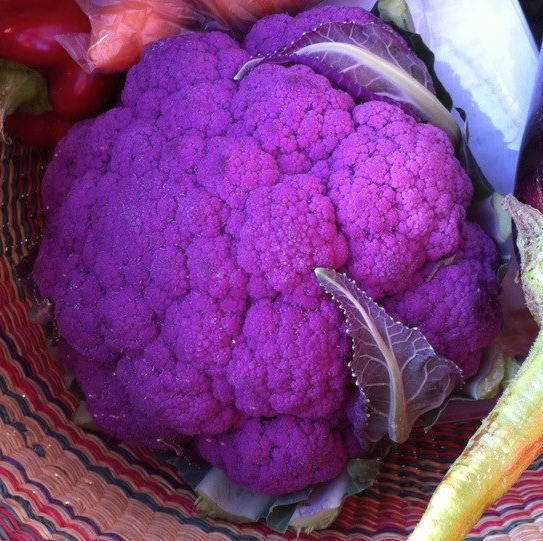
Purple Cauliflower Pickles

I believe I have mentioned Michael Ruhlman's book, Ratio a number of times with regard to pickle making. Generally speaking,  it is quite a useful little cooking manual for some very basic preparations, just one of which is an extremely easy method for naturally fermented pickles. I keep trying various vegetables, of which the celery root was not successful.  Don't bother pickling that one.  However, I thought these purple cauliflower pickles deserving of their very own post.

Sometimes a vegetable will just call to me from the bins at our market.  Broccoli Romanesco was like that.  So beautiful and unusual, a natural approximation of a fractal.  The purple cauliflower stopped me in my tracks as well.


I decided to pickle the boy, combined with some wedges of daikon (large Japanese type of white radish).  In common with beets, this cauliflower will eventually turn the whole batch a brilliant burgundy color.  The good news is, that's not a dye of any sort. Purple cauliflower gets its beautiful hue, which can vary in depth, from the presence of the antioxidant anthocyanin, which is also found in red cabbage and red wine.  It has the same texture, and firmness as the white variety, with a mild, slightly sweet and nutty taste.

Here it is starting out, with the air-lock on the kitchen counter.


11/06/2015

Book Review - The Hundred-Foot Journey, by Richard C. Morais


Our current (October-November) Cook the Books Club selection, The Hundred-Foot Journey, a novel by Richard C. Morais, was titled for the very short distance between two eating establishments in his story, French and Indian, though the journey between cultures is much longer.

An Indian family flee their home and restaurant in Mumbai, after the mother's tragic death in a riot, though not without first selling their property and making that escape with some solid cash.  After a brief unhappy stay in England, they move again, this time (after some driving around Europe, looking for a future home, in three second-hand Mercedes), they finally settle in the little French mountain village of Lumière.

There, right across the street from a well-known (to epicures) classic French Inn and Restaurant, run by a snooty, unhappy woman, though an excellent chef, Papa decides to open a colorful, noisy, family style Indian Restaurant, Maison Mumbai  You can just imagine the fire-works.  Literally in the case of the troop from India, with classic Hindustani music blaring out over speakers in the garden.  Their new neighbor is not thrilled, to say the least.

10/01/2015

The Great Moringa, Miracle Tree, Project and Spicy Lentils


 Here is my moringa tree patch, right after a good pruning

My long awaited post.  The Moringa tree, also known as Drumstick tree, or the Miracle Tree, is said to have the ability to cure over 300 diseases.  Just quoting research here.  From a food point of view, Moringa leaves can be used like spinach, though they are far more nutritious. Sorry Popeye.  And I love the nutty, legume scent of the leaves when picked fresh.

The leaves can be used fresh or dried into a powder, are an excellent source of vitamin A and C, a good source of B vitamins, and among the best plant sources of minerals. The calcium content is very high, iron is good enough to treat anemia — three times that of spinach — and it’s an excellent source of protein while being low on fats and carbohydrates. Said another way, Moringa leaves have seven times the Vitamin C of oranges, four times the calcium of milk, four times the vitamin A of carrots, three times the potassium of bananas, and two times the protein of yogurt.

 That’s quite a line up. The leaves also have the sulfur-containing amino acids methionine and cystine. Medically it is antibiotic and research shows it can be used to treat high blood pressure. A leaf tea is used by diabetics to help regulate their blood sugar. It is full of antioxidants, is anti-cancerous, and when eaten by mothers they give birth to healthier, heavier babies.  A 28 December 2007 study said a root extract is very anti inflammatory.