Showing posts with label Hawaiian herbs. Show all posts

10/24/2011

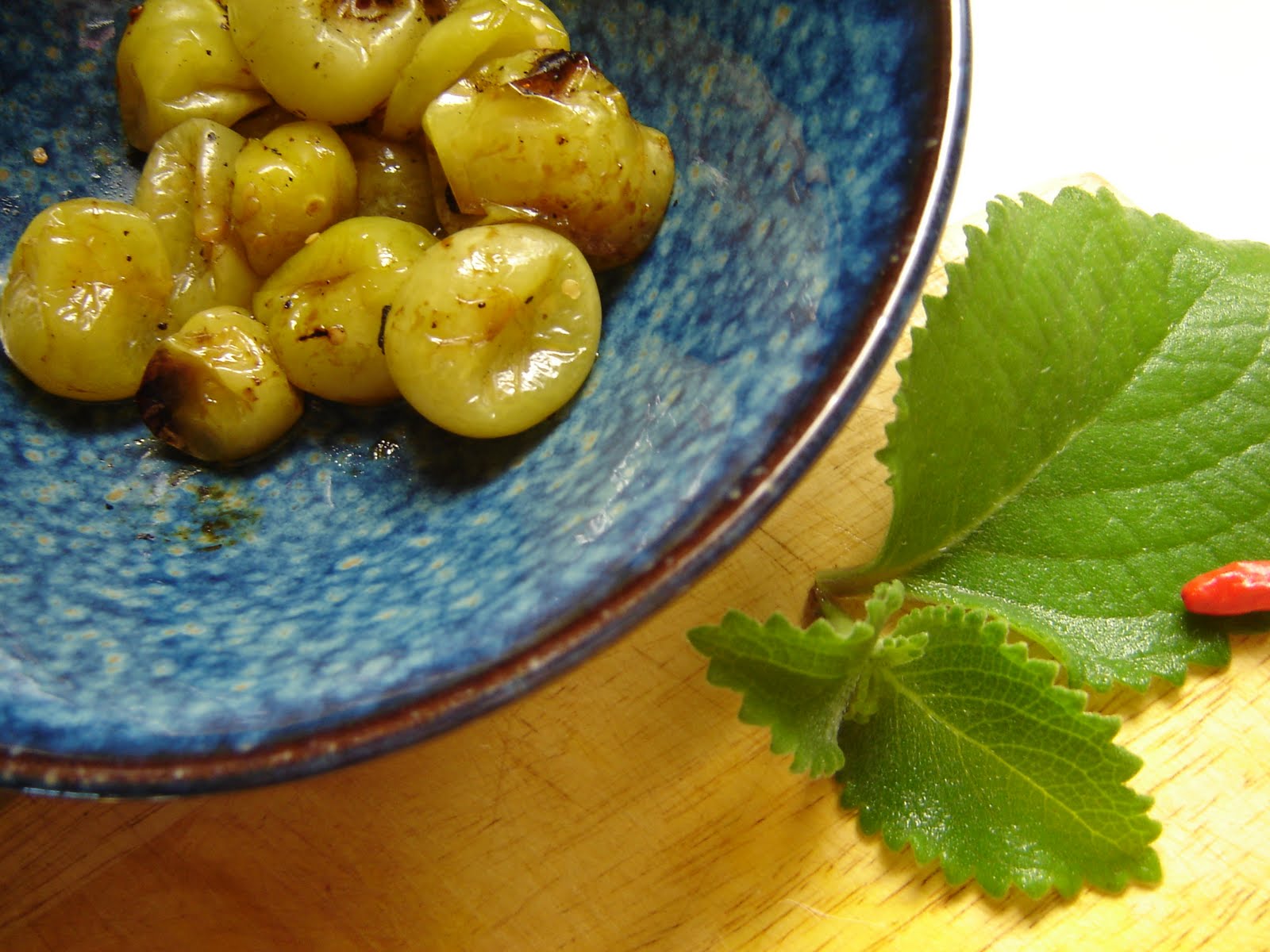
Guacamole with Tomatillos and Easy Baked Tortilla chips

Guacamole responds nicely to the tang of tomato, though that does seem to dull things out color wise.  Red being opposite on the color wheel, you could create some gray if you were dabbling.  Tomatillos, on the other hand, being green(ish) and also being on the tangy side are the bees' knees.  I think they used to say that way back in the day before the day.  Besides which my garden happens to be jumping with them at the moment.  Not that either substance here is a vivid green, but we don't want to muddy things up more than we have to.  Those few flecks of red chili pepper keep to themselves pretty much.


You only need one tiny Hawaiian chili pepper to get a good zap of hot.  A bit of Cuban oregano, just because it's from South of the Border, a plant that grows wild in the tropics, it's actually Plectranthus amboinicus,  a tender fleshy perennial plant in the family Lamiaceae with an oregano-like flavor and odor.  Some people call it Cuban Oregano or Mexican Mint.  Nothing like mint.  Don't be calling it that.


I add a little chopped onion, salt and lemon juice for overall yummyness.  Also, char broiling the tomatillos is a way of cooking them to bring out maximum flavor.  So, you do that first.  Then let them cool while you're mashing avos and chopping things.

6/03/2010

Pasta With Herbs and Sardines

The theme this week at I Heart Cooking Clubs is Herbs.  Mine was going to be a particular oregano, actually Cuban Oregano,  which grows like a weed here, a nice perennial, always available.  I'm still learning what it goes best with.  I used it to finish Mark Bittman's Pasta with Sardines, and found the dish okay, but still lacking a zip and sprightliness I was looking for, to offset the oily sardines.  When I added cilantro, it was just amazing how much the overall taste profile changed for the better.  Bittman used regular parsley, but as he notes, more for the color.  I think cilantro works both to lift  flavor as well as appearance.
Very often, by the end of the day, and the meal preparation, I am very tired.  Duh.  Who isn't?  Maybe you 20 somethings.  At any rate my dishes frequently improve at a second serving.  Since I am the Left-Over Queen (or one of them), that would be my lunch next day, which is when the cilantro got added.  Bob hates the stuff anyway.

5/30/2010

Sage Infused Tofu in Roasted Peanut Sauce for TGRWT #21

It's been quite some time since we've had a new challenge from the cutting edge folks at TGRWT, otherwise known as They Go Really Well Together.  The latest is a pairing of sage and roasted peanuts, being modestly hosted by Greg of Humbling Attempts at Creativity.   Go to the TGRWT site for some of the stranger challenge combinations from past months.

Greg mentioned a few other food items that share volatile compounds (the basic operative principle here) with BOTH sage and roasted peanuts, among which were:  Basmati rice, butter and kecap manis sauce, which is a medium sweet soy sauce.   Those were the  additional flavor compatibles I included in this dish.

11/28/2009

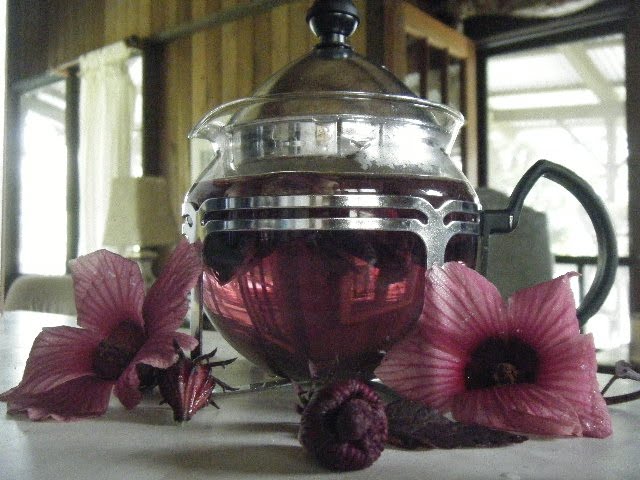
Rosey Tea and Pumpkin Pie

Tea in a basket.  This should actually be called a Tisane.  I collected from our gardens, Red Zinger hibiscus flowers and buds, lemongrass, some kumquats and a couple of allspice leaves.  Pour boiling water over and there's your tea.  Well, not exactly.  I just used a bit of zest from one of the kumquats.  I'm going to make a Starfruit Chutney and add the remaining kumquats to that (I love the word - just something about it, reminds me of an old W.C. Fields movie, where he calls Mae West, "My little Kumquat" in his inimitable style.

My daughter, granddaughter, and her Silkie chicken joined me.  It was a ladies' tea.  With leftover pumpkin pie.  Those hibiscus flowers and buds made the lovliest rose color in the pot.
Actually, there was one piece of pie left, and two custards with whipped cream.  With the extra pumpkin pie filling I baked two souffle dishes in a bain marie (larger pan filled with water in which souffle dishes are sitting).  For the pumpkin pie this year I used what was left after my soup, defrosted, dumped into the blender with some cream cheese, eggs, cream, cloves, nutmeg, cinnamon, sugar, bourbon, and of course, the inevitable ground Wattleseeds.  They're finding their way into all sorts of dishes lately, as part of my ongoing experiment in using the suckers up.  In this instance, the flavor was there, not pronounced, but a presence bringing the usual pumpkin pie spices up a notch.  I added extra cream and cream cheese as I wanted a less dense pumpkin, more cheese cakey kind of thing, but not.  If you know what I mean.
 
This tea was also fine iced.  I just looooove the color.

6/09/2009

And Pretty Yellow Flowers

Here's another in the formerly obnoxious weeds of the garden category. Not a weed to everyone though. My gardening helper/expert has been planting them around trees and in my raised vegetable bed. When people would ask me why, and aren't those pods poisonous? I would say something ignorant like, I think they're some kind of companion plant. Every tree needs a friend. Or, people use the seeds to worm their horses or dogs.... I think.

Well, decided it was time to get more knowledgeable on the subject. I asked Sean how to spell Crotalaria, but he wasn't sure. Knew the common name was Sun Hemp though, so I had a Googleable name. What a marvelous thing the interweb is.
Crotalaria juncea
A tall East Indian shrub, Crotalaria juncea, known also as Sun Hemp, of the legume family, having slender branches and yellow flowers, and an inner bark that yields a hemplike fiber used for making ropes, sacking, etc.

Crotalaria juncea L. is a rapid growing crop that is used for fiber production in Indo-Pakistan. It is also good for use as a green manure in many tropical and subtropical areas in the world as an organic and nitrogen source. It suppresses weeds, slows soil erosion, and reduces root-knot nematode populations (Rotar and Joy, 1983). When plowed under at early bloom stage, nitrogen recovery is the highest. *Tropic Sun* sun hemp can produce 150 to 165 kg/ha of nitrogen and 7 t/ha air-dry organic matter at 60 days of growth under favorable conditions (Rotar and Joy, 1983). In southwestern Alabama, plants grown for 9 to 12 weeks produced 5.9 t/ha dry-matter and 126 kg N/ha (Reeves et al., 1996). Leaving these residues on the soil surface over the winter resulted in the release of 75 to 80 kg N/ha (Reeves et al., 1996). In the tropics, *Tropic Sun* grows and produces seed year round at elevation of 0 to 300 m, and in summer up to 600 m. In Guam and Puerto Rico, C. juncea is grown under conditions similar to Hawaii. In the continental United States, C. juncea is adapted to spring and summer planting in the South and Southwest (Rotar and Joy, 1983) and can be grown as a winter cover crop in Alabama (Reeves et al., 1996). It is suitable as a green manure crop as far north as Maryland, but may not seed well north of 30* latitude.

As with many other members of the genus, C. juncea contains pyrrolizidine alkaloids, which are converted into potent toxins in the liver. Highest alkaloid levels are found in the seeds. Toxicity varies from toxic to non-toxic among genotypes. Laboratory tests and feeding trials with the Hawaiian variety, 'Tropics Sun', suggest that both seeds and forage of are nontoxic. Stress conditions may also affect the degree of toxicity. To reduce chances of poisoning, it is best to limit C. juncea forage intake to no more than 45% in rations for sheep, 10% for cattle, and not fed at all to horses and pigs.
So, looks like it does quite a lot towards improving a garden. Suppresses weeds, produces nitrogen, and reduces nematode populations. Plus, not toxic to animals in moderate quantities. And, pretty yellow flowers too. I don't think you're supposed to smoke it though.
Whataya know, glad we checked into it. Now I won't sound so dumb when people ask.

6/02/2009

Leaf of Life

This is not it
Today I discovered some information about two more of the "weeds" in my garden. One I think I can leave in the weed category and not have any angst about ripping it out. Pictured above, it is known variously as Wild Tobacco, and Woolly Nightshade, officially as Solanum mauritianum.

It is poisonous, and handling the plants can apparently cause irritation and nausea. I didn't notice any, but after I read that, I immediately washed my hands.

On the other side of the spectrum of good and evil, there is the "Leaf of Life", (Kalanchoe pinnata) also known as air plant, miracle leaf, goethe and the katakataka plant.


This little baby, which heretofore I'd pretty much barely tolerated, has all sorts of wonderful, healthful applications. Also, though admittedly rather decorative, it has the ability to propagate itself from each and every dropped leaf. But now I'll be looking at my air plants differently. To give you an idea of the extent of its use, from an interesting site on Tropical herbs.

TRIBAL AND HERBAL MEDICINE USES

Kalanchoe is somewhat of a panacea to the indigenous peoples of the Amazon; they employ it for many different purposes. The Creoles use the lightly roasted leaves for cancer and inflammations, and a leaf infusion is a popular remedy for fevers. The Palikur mix the leaf juice with coconut oil or andiroba oil and then rub it on the forehead for migraines and headaches. To the Siona indigenous peoples, kalanchoe is known as 'boil medicine' and they heat the leaves and apply them topically to boils and skin ulcers. Along the Rio Pastaza in Ecuador, natives use a leaf infusion for broken bones and internal bruises. In Peru, indigenous tribes mix the leaf with aguardiente (sugar cane rum) and apply the mixture to the temples for headaches; they soak the leaves and stems overnight in cold water and then drink it for heartburn, urethritis, and fevers. The root is also prepared as an infusion and used for epilepsy. Other tribes in the Amazon squeeze the juice from fresh leaves and mix it with mother's milk for earaches.

Throughout South America kalanchoe has had a long history of use. It is commonly called the 'miracle leaf' and 'life leaf' for its remarkable healing properties. In Brazil the plant is considered a sedative, wound-healer, diuretic, anti-inflammatory and cough suppressant. It is used for all sorts of respiratory conditions-from asthma and coughs to bronchitis. It is also employed for kidney stones, gastric ulcers, skin disorders and edema of the legs. Externally a leaf infusion or the leaf juice is used for headaches, toothaches, earaches, eye infections, wounds, ulcers, boils, burns and insect bites. In Peru the plant is employed for the same uses. In Mexico and Nicaragua kalanchoe is used for similar purposes and also to promote menstruation and assist in childbirth.


God has given us such an amazing world. So much to learn, absorb, use. I've started a collection of pages with pictures and information on what is growing around here. We have a veritable pharmacy right at hand.