Showing posts with label gardening. Show all posts

11/30/2024

Praising God and Practicing Gratitude!

Thanksgiving is a great time to practice gratitude!  Doing that here, whilst Joining up with Deb Nance of Readerbuzz for her Sunday Salon.


We are celebrating many things!  Family, friends, good food, fruit from our trees, and this week a report of over 9,000 shoebox gifts  collected at our Operation Christmas Child Hilo Drop Off location! The boxes go to hurting and impoverished children in Third World countries and other places, wherever folks are going through various disasters, to orphanages, etc. This is the second and final container.

11/23/2024

Much to be Thankful For!


ABSOLUTELY!! Looking back at the highlights of our week, to be posted on the Sunday Salon, hosted by Deb Nance of Readerbuzz. Did you know that Wednesday, the 20th was National Absurdity Day? Well, I happen to have one of those calendars that let you know all the important days! We had a fun drive to Waimea on Wednesday, ate at my favorite restaurant and shopped at my favorite (one of them) dress shops, while Bob took care of some Real Estate.

A Thanksgiving Lunch

Going into the week approaching Thanksgiving we do have much to be thankful for, and to celebrate!  Since my grandson and family are going to be away on the Mainland, for the holiday visiting the other grandparents, he took us out to lunch.  The kids were adorable and amusing!  Bob was taking the pictures and mom got lopped off.

11/02/2017

Pacific Spinach Cannelloni and Nero Wolfe


 Don't you love discovering new authors and new foods?   Rex Stout's Nero Wolfe Mysteries have just done it.  He's been around (1886-1975) for quite a few years, but new to me all the same.  The detective hero, Nero Wolfe, head of his own agency,  has been described as "overweight, epicurean and orchid-loving."  And I love how he spends as much time with the orchids as he does solving mysteries and helping his chef, Fritz, to perfect various culinary creations.  In the first of this volume, two novels in one, Black Orchiids and The Silent Speaker, Fritz was making some special sausages, saucisse minuit.  Later on he and Nero, on the advice of a Southern girl, material witness in an ongoing murder investigation, tried adding chitlins to a batch of corned beef hash, in a quest to solve that cooking problem, of nearly equal importance to solving the identity of the murderer.

1/24/2015

Ode to Pigeon Peas


I walked out in the garden this morning,
  Sun warming my head, my arms,
And the green pigeon peas. 
A breath of legume, sun teased scent
   Brought them to my attention.
Picked a handful, then two.
Dropped into boiling salted water
   For 10 minutes or so, cooled in a colander,
   Shelled -  lifted from their
 Plump nurturing pods, some
   Kissed a bit brown by that sun.
Suitable now for our salad,
Or pigeon peas 'n pasta
With basil and tomato.
                                     .... C. Riley

Well, that was my inspiration (inspired to poetry as well as food) from our latest Cook the Books Club pick, Sustenance & Desire, an anthology of poems, essays and various excerpts, loosely associated with food, edited with paintings by Bascove.  I would give the book mixed reviews.  Overall a bit uneven in quality and interest.  Some of the poems mystifying, some mediocre and several excellent, of course all in my humble opinion.  Among the essay selections, I enjoyed a few, some were okay and a number of others could be done without entirely; for instance the piece on cannibalism.  Did you know that:
"The Aztec cared intensely how they ate people and also who they ate, when, and where."
Not particularly appetizing.  That said however, her art alone was worth the book purchase.  I tried to find any Bascove paintings on ebay, but none were available.  Must all be in private collections or museums.

11/17/2010

Hawaiian Mushroom Reprise

Some mushrooms just call out to have their photos taken.  Popping up between other plants....odd little mycelium stools for wandering toads.  And, what a pretty net skirt, and strange brain-like head. My goodness.

It's supposed to be edible, when in this early stage.  But, anything called an orange-netted stinkhorn is not something I want to put in my mouth.  Especially with a notation in Mushrooms of Hawaii that reads:  "Odor strongly fetid."  I do want to cultivate some known, tasty, edible mushrooms, since my great shitake experiment was a total failure.  Not one of the little plugs produced anything.  However, I did read today (whilst trying to identify some of these) that oyster mushrooms are the easiest to cultivate.....so......we shall try.

Now this one is harder to identify. I'm working on it.  Indoors, we can do a spore print, look at the gills and annulus or lack of, etc.  There are some little nibbles out of one.  Apparently the snails think it's tasty.  Even with the book, I'm not sure here.

Another odd fellow.  He's a sort of a black coral guy.  Can't find him in either of my books, but for now will call it Black Coral Fungus.  The photo doesn't really do them justice.  They are definitely black, with lighter tips, but I need a better camera, looks like.  If any of you can identify this sort, leave a comment.  Growing in mulch under a Wi Apple seedling.


These are the mushrooms that did grow, on the logs into which I carefully stuck shitake plugs. Turkey-tail Polypore.  Very seasonal.  They are beautiful, as a bright side to the story.  And a variety now known to be an immune system enhancer.  Has been used in China to treat various types of cancer. The little fallen blossoms are cacao.

3/27/2010

Eat Local - Snails

 Aren't they lovely?
This is my encouragement for you all to eat these pests.  I can't, because they're a bit of trouble to prepare and I would be the only one in our family eating them.  Therefore, since my plan is to sell them, it is important that YOU EAT THEM!  Now the only problem is finding escargot lovers who would like a fairly regular supply.  BTW, the ones in my photos are young, they get much bigger. I found some interesting information about our local (invading) variety on this site, as cited below:
West Africa giant snails. archachatina marginata and achatina achatina
Snail meat is high in protein (37-51%) compared to that of guinea pig (20.3%), Poultry (18.3%), Fish (18%), Cattle (17.5%), Sheep (16.4%) and Swine (14.5%). Iron content (45-59mg/kg), low in fat (0.05-0.08%) and contains almost all the amino acids needed for human nutrition. In addition to the nutritional value of snail meat, recent studies indicated that the glandular substances from edible snails cause agglutination of certain bacteria, which could be of value against a variety of ailments including whooping cough. In folk medicine, the bluish liquid obtained when the meat has been removed from the shell is believed to be good for infant's development. It is believed in some quarters that snail meat contains pharmacological properties of value in counteracting high blood pressure.
At the imperial Court in Rome, snail meat was thought to contain aphrodisiac properties and was often served to visiting dignitaries in the late evening. The high Iron content of snail meat is considered important in the treatment of anemia and in the past the meat was recommended as a means of combating ulcers and asthma.
There is a flourishing international trade of snails in Europe and North America. In France the annual requirement is about 5 million kg, over 60% of which is imported. The estimated annual consumption in Italy is 306 million snails. In West Africa, snail meat has traditionally been a major ingredient in the diet of people living in the high forest belt. In the Cote d'Ivoire, for example, an estimated 7.9 million kg is eaten annually. In Nigeria, although the consumption figures are not available, it is clear that demand outstrips supply.

3/10/2010

Strange Fruits

 
My latest citrus acquisition.  New member of the family.  These beguiling little fruits are in their infancy, some just barely in toddler stage.  Citron Hands, also known as Buddha's Hand (possibly because of its Asian origin?), came from North East India and migrated to China in the 4th century.  They seem to be in a praying position. Might be saying, yes, you too can pray.  Just try.
 
It's pointing at me.
The mature fruits are supposed to be beautifully fragrant and are used to perfume a room in China and Japan.  What a thought.  No more room aerosols.  Just put one of these babies in every bathroom.  Although there is no juice, the white pith is not bitter, so the whole fruit can be used in cooking. I have been inspired by Linda, a very innovative,  professional chef, doing some incredible things with citrus at her site.

I am sitting on the edge of my seat waiting for these guys to grow up already.  I want to know what it smells like, how is the taste different from other types of citrus, how can they be used to best advantage??  It's telling me, just wait.  Hey, no rush.  Maybe we'll learn patience here.

11/28/2009

Rosey Tea and Pumpkin Pie

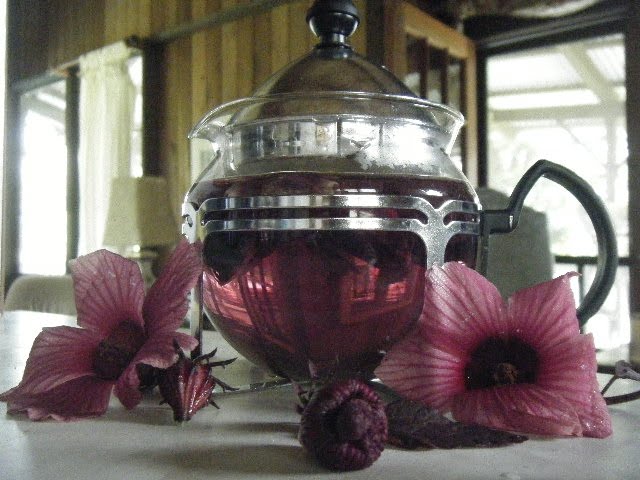
Tea in a basket.  This should actually be called a Tisane.  I collected from our gardens, Red Zinger hibiscus flowers and buds, lemongrass, some kumquats and a couple of allspice leaves.  Pour boiling water over and there's your tea.  Well, not exactly.  I just used a bit of zest from one of the kumquats.  I'm going to make a Starfruit Chutney and add the remaining kumquats to that (I love the word - just something about it, reminds me of an old W.C. Fields movie, where he calls Mae West, "My little Kumquat" in his inimitable style.

My daughter, granddaughter, and her Silkie chicken joined me.  It was a ladies' tea.  With leftover pumpkin pie.  Those hibiscus flowers and buds made the lovliest rose color in the pot.
Actually, there was one piece of pie left, and two custards with whipped cream.  With the extra pumpkin pie filling I baked two souffle dishes in a bain marie (larger pan filled with water in which souffle dishes are sitting).  For the pumpkin pie this year I used what was left after my soup, defrosted, dumped into the blender with some cream cheese, eggs, cream, cloves, nutmeg, cinnamon, sugar, bourbon, and of course, the inevitable ground Wattleseeds.  They're finding their way into all sorts of dishes lately, as part of my ongoing experiment in using the suckers up.  In this instance, the flavor was there, not pronounced, but a presence bringing the usual pumpkin pie spices up a notch.  I added extra cream and cream cheese as I wanted a less dense pumpkin, more cheese cakey kind of thing, but not.  If you know what I mean.
 
This tea was also fine iced.  I just looooove the color.

6/09/2009

And Pretty Yellow Flowers

Here's another in the formerly obnoxious weeds of the garden category. Not a weed to everyone though. My gardening helper/expert has been planting them around trees and in my raised vegetable bed. When people would ask me why, and aren't those pods poisonous? I would say something ignorant like, I think they're some kind of companion plant. Every tree needs a friend. Or, people use the seeds to worm their horses or dogs.... I think.

Well, decided it was time to get more knowledgeable on the subject. I asked Sean how to spell Crotalaria, but he wasn't sure. Knew the common name was Sun Hemp though, so I had a Googleable name. What a marvelous thing the interweb is.
Crotalaria juncea
A tall East Indian shrub, Crotalaria juncea, known also as Sun Hemp, of the legume family, having slender branches and yellow flowers, and an inner bark that yields a hemplike fiber used for making ropes, sacking, etc.

Crotalaria juncea L. is a rapid growing crop that is used for fiber production in Indo-Pakistan. It is also good for use as a green manure in many tropical and subtropical areas in the world as an organic and nitrogen source. It suppresses weeds, slows soil erosion, and reduces root-knot nematode populations (Rotar and Joy, 1983). When plowed under at early bloom stage, nitrogen recovery is the highest. *Tropic Sun* sun hemp can produce 150 to 165 kg/ha of nitrogen and 7 t/ha air-dry organic matter at 60 days of growth under favorable conditions (Rotar and Joy, 1983). In southwestern Alabama, plants grown for 9 to 12 weeks produced 5.9 t/ha dry-matter and 126 kg N/ha (Reeves et al., 1996). Leaving these residues on the soil surface over the winter resulted in the release of 75 to 80 kg N/ha (Reeves et al., 1996). In the tropics, *Tropic Sun* grows and produces seed year round at elevation of 0 to 300 m, and in summer up to 600 m. In Guam and Puerto Rico, C. juncea is grown under conditions similar to Hawaii. In the continental United States, C. juncea is adapted to spring and summer planting in the South and Southwest (Rotar and Joy, 1983) and can be grown as a winter cover crop in Alabama (Reeves et al., 1996). It is suitable as a green manure crop as far north as Maryland, but may not seed well north of 30* latitude.

As with many other members of the genus, C. juncea contains pyrrolizidine alkaloids, which are converted into potent toxins in the liver. Highest alkaloid levels are found in the seeds. Toxicity varies from toxic to non-toxic among genotypes. Laboratory tests and feeding trials with the Hawaiian variety, 'Tropics Sun', suggest that both seeds and forage of are nontoxic. Stress conditions may also affect the degree of toxicity. To reduce chances of poisoning, it is best to limit C. juncea forage intake to no more than 45% in rations for sheep, 10% for cattle, and not fed at all to horses and pigs.
So, looks like it does quite a lot towards improving a garden. Suppresses weeds, produces nitrogen, and reduces nematode populations. Plus, not toxic to animals in moderate quantities. And, pretty yellow flowers too. I don't think you're supposed to smoke it though.
Whataya know, glad we checked into it. Now I won't sound so dumb when people ask.

6/02/2009

Leaf of Life

This is not it
Today I discovered some information about two more of the "weeds" in my garden. One I think I can leave in the weed category and not have any angst about ripping it out. Pictured above, it is known variously as Wild Tobacco, and Woolly Nightshade, officially as Solanum mauritianum.

It is poisonous, and handling the plants can apparently cause irritation and nausea. I didn't notice any, but after I read that, I immediately washed my hands.

On the other side of the spectrum of good and evil, there is the "Leaf of Life", (Kalanchoe pinnata) also known as air plant, miracle leaf, goethe and the katakataka plant.


This little baby, which heretofore I'd pretty much barely tolerated, has all sorts of wonderful, healthful applications. Also, though admittedly rather decorative, it has the ability to propagate itself from each and every dropped leaf. But now I'll be looking at my air plants differently. To give you an idea of the extent of its use, from an interesting site on Tropical herbs.

TRIBAL AND HERBAL MEDICINE USES

Kalanchoe is somewhat of a panacea to the indigenous peoples of the Amazon; they employ it for many different purposes. The Creoles use the lightly roasted leaves for cancer and inflammations, and a leaf infusion is a popular remedy for fevers. The Palikur mix the leaf juice with coconut oil or andiroba oil and then rub it on the forehead for migraines and headaches. To the Siona indigenous peoples, kalanchoe is known as 'boil medicine' and they heat the leaves and apply them topically to boils and skin ulcers. Along the Rio Pastaza in Ecuador, natives use a leaf infusion for broken bones and internal bruises. In Peru, indigenous tribes mix the leaf with aguardiente (sugar cane rum) and apply the mixture to the temples for headaches; they soak the leaves and stems overnight in cold water and then drink it for heartburn, urethritis, and fevers. The root is also prepared as an infusion and used for epilepsy. Other tribes in the Amazon squeeze the juice from fresh leaves and mix it with mother's milk for earaches.

Throughout South America kalanchoe has had a long history of use. It is commonly called the 'miracle leaf' and 'life leaf' for its remarkable healing properties. In Brazil the plant is considered a sedative, wound-healer, diuretic, anti-inflammatory and cough suppressant. It is used for all sorts of respiratory conditions-from asthma and coughs to bronchitis. It is also employed for kidney stones, gastric ulcers, skin disorders and edema of the legs. Externally a leaf infusion or the leaf juice is used for headaches, toothaches, earaches, eye infections, wounds, ulcers, boils, burns and insect bites. In Peru the plant is employed for the same uses. In Mexico and Nicaragua kalanchoe is used for similar purposes and also to promote menstruation and assist in childbirth.


God has given us such an amazing world. So much to learn, absorb, use. I've started a collection of pages with pictures and information on what is growing around here. We have a veritable pharmacy right at hand.